September 11, 2001. George was on vacation, but he put on his flight suit and went into his squadron anyway. Because he had to do something. Because he couldn't just stay home and watch the horror.
I stayed home and watched the horror because I had no other choice. I remember vividly what that horror felt like.
I recently watched a video clip about the aftermath of floods in Vermont. The spirit of community and working together is very human and sadly beautiful. Nature dumps on us, and we keep going. It's messy and hard and for some people beyond tragic, but nevertheless we keep going.
Nature is impartial. The Vermont floods happened because Hurricane Irene just happened to run up the east coast. Ditto for New Orleans and Katrina. The earthquake in Japan happened because tectonic plates moved. Ditto for the quakes in Haiti and New Zealand, and Monday's quake in Sumatra.
The events of 9/11 were harder to process. On that day, it wasn't random Nature doing what Nature does. It was hate. And we all knew it. Not just Americans; the whole world knew. And while part of the world rejoiced at our loss, most people were horrified. And many of those people reached out in sympathy and compassion.
That kind of hate is hard to process. It's a collective hate...the hate of one culture for another. The kind of hate that sparks wars and leaves so many innocent victims in its wake. It led to hate in the form of threats on mosques in the United States. It led to Enduring Freedom and Navy Seals killing Osama Bin Laden. While I'm not exactly sad Bin Laden is dead, I don't understand why so many people took to the streets to celebrate. Justice is one thing. Glee in another human's violent death is something entirely different.
Eye for an eye. And we all end up blind.
I'd like to remember the horror because I don't want to forget. I don't want to forget footage of Father Judge's body being carried from the rubble. I don't want to forget how many firefighters and police officers lost their lives. I don't want to forget the footage of emergency medical staff waiting in vain for survivors to be pulled from the rubble. I don't want to forget how the passengers on Flight 93 took matters into their own hands and saved who knows how many people. I don't want to forget the service of those at the Pentagon. I don't want to forget the 3,000 people who died that day. I don't want to forget what happened afterwards. What happened in our hearts. What we did to heal.
I want to remember.
Real Simple Magazine published an article in which family and friends of victims share how they keep their memories alive. It's beautiful. People Magazine is featuring chilren of 9/11 on its cover. I haven't read it yet but probably will because I remember seeing very pregnant women and some women with babies on their laps on Good Morning, America, months after the horrible day.
I'd like to see what those belly bumps and swaddled infants are up to these days. Their innocent lives changed that day and yet they keep going.
It's tragic. And beautiful. Because we keep going. Because we remember.
Showing posts with label perspective. Show all posts
Showing posts with label perspective. Show all posts
Tuesday, September 6, 2011


Wednesday, August 10, 2011
The Difference between Adults and Children
Here's a picture of pure childhood joy standing on an inflatable in a lake.

Here's a picture that further contextualizes that joy.
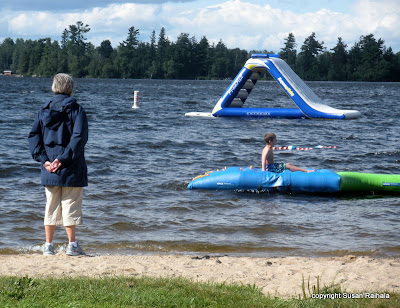
Children do not feel cold. Adults, however, do not consider it advisable to get into a lake when the air temperature is 65 degrees F and the breeze is gusting to twenty miles per hour. Instead, adults put on a coat.
Joy comes in many temperature settings.

Here's a picture that further contextualizes that joy.

Children do not feel cold. Adults, however, do not consider it advisable to get into a lake when the air temperature is 65 degrees F and the breeze is gusting to twenty miles per hour. Instead, adults put on a coat.
Joy comes in many temperature settings.
Tuesday, July 12, 2011
And Again She Dwells on the Happiness Project...
Gretchen Rubin's Happiness Project fascinates me. First of all, it proves that I'm not crazy...at least one other human on this planet thinks about happiness obsessively and feels compelled to share her thoughts with the world, and given the popularity of the Happiness Project, lots of other people obsess about it, too. Fortunately, Gretchen is even more obsessive than I am so she provides amazing research and resources in her book and on her blog to promote the idea of happiness as a worthy pursuit.
One theme in her book that resonated with me was her resolve to Be Gretchen. She decided to pursue interests that truly represented her...not the interests she felt she should have. A recent post on her blog explores this idea as she processes her new-found, extremely obsessive interest in smell.
At various times in my life, I've pursued knowledge because I thought I ought to, not because I truly was passionate about it. A perfect example of this was my desire to major in science. Despite the fact that I was reading at age three and never went anywhere without a book, I felt like I should be interested in science because a woman scientist told me that women were discouraged from pursuing the sciences. The surest way to get me to do something is to tell me I can't do it, and I felt outraged that women were under-represented in the sciences because men thought they couldn't do science. Hmmph. I could fix that.
Fortunately, my intellectual hubris encouraged me to take organic chemistry my first semester at Duke University...where half the freshman class declares pre-med as their major. Pride goeth before the fall. Courses like organic chemistry serve as "weeder" courses, designed to weed out those who are not really prepared for medical school, and thus are made to be extremely difficult. Most students wait until junior or senior year to take organic chemistry, but there I was, a 17-year-old freshman, in way over my head.
When I flunked an exam, I was forced to admit that my drive to be a chemist didn't play to my strengths. A very kind aunt pointed out that the world would not end if I quit running down a path destined to kick my ass. In short, she gave me permission to be myself instead of someone I thought I wanted to be. Instead, I changed majors to a subject that welcomed me with poetry and metaphor and litotes and all things medieval.
I included litotes in the list because it's hopelessly obscure and highlights how weird and wonderful my interests are...at least to me. Litotes, the deliberate use of understatement, appears often and interestingly in Anglo-Saxon literature (think Beowulf), but one of my favorite examples comes from Samuel Johnson: "To write is, indeed, no unpleasing employment."
Indeed.
I've already written, not unpleasingly, about my passion for medieval literature, but my pursuit of that obscure branch of literary brilliance never dampened my love for all sorts of reading, from the highest levels of artistic merit (think Joyce's Ulysses) to the least (think People Magazine).
Grandma always had Reader's Digest in her house; I grew up reading it. So when I got a call from the Special Olympics last year to subscribe to Reader's Digest, I did. George is baffled by this. "I just can't imagine you enjoying Reader's Digest." He remembers only too well my years as an intellectual snob. I've gotten over that and am back enjoying a much broader range of reading, including Reader's Digest. So what if Reader's Digest is not PMLA or Medium Aevum or South Atlantic Quarterly. None of my readings in those peer-reviewed scholarly journals ever made me laugh or tugged at my heartstrings like jokes and stories in Reader's Digest do.
While immersed in the academic world, I didn't read Reader's Digest because I was too busy reading Medium Aevum and the works of Dante and Chaucer. There are, after all, only so many hours in the day. I was writing scholarly essays, participating in scholarly conferences, and teaching college classes. Life eventually took me out of university, and after a while, I realized that the artificial narrowing of interest I experienced in graduate school no longer applied.
Life moves on. My passion for medieval literature stays with me, but it's not all-consuming anymore. While part of me is a little sad about that, the majority of my synapses are quite thrilled to pursue new interests. Science still fascinates me, and that has come in handy while trying to deal with the whole autism thing. Children's literature delights me as much as Chaucer and Shakespeare ever could, and Mental Floss introduces me to subjects I didn't even know existed.
The world is no small place, and it's positively bursting with amazing, fascinating, miraculous stuff. Why would we ever think that any part of it would be unworthy of our attention? Why would we suppress our natural interests and inclinations because somehow they seem a little weird or not sophisticated/smart/popular/cool enough?
Why do we try to be who we think we want to be instead of who we are?
This wonderful quotation popped up recently on Pinterest, and it speaks directly to this theme.

Screw the critics--especially the ones that live in our own heads. Pursue what you love, what interests you, regardless of what others might think. Doing so can increase your happiness.
Be you, and see what happens.
Please share your thoughts in the comments. Is there any passion in your life that you pursue despite others thinking you're weird? Is there a passion you would spend more time on if you weren't afraid it would make you look odd to others?
One theme in her book that resonated with me was her resolve to Be Gretchen. She decided to pursue interests that truly represented her...not the interests she felt she should have. A recent post on her blog explores this idea as she processes her new-found, extremely obsessive interest in smell.
At various times in my life, I've pursued knowledge because I thought I ought to, not because I truly was passionate about it. A perfect example of this was my desire to major in science. Despite the fact that I was reading at age three and never went anywhere without a book, I felt like I should be interested in science because a woman scientist told me that women were discouraged from pursuing the sciences. The surest way to get me to do something is to tell me I can't do it, and I felt outraged that women were under-represented in the sciences because men thought they couldn't do science. Hmmph. I could fix that.
Fortunately, my intellectual hubris encouraged me to take organic chemistry my first semester at Duke University...where half the freshman class declares pre-med as their major. Pride goeth before the fall. Courses like organic chemistry serve as "weeder" courses, designed to weed out those who are not really prepared for medical school, and thus are made to be extremely difficult. Most students wait until junior or senior year to take organic chemistry, but there I was, a 17-year-old freshman, in way over my head.
When I flunked an exam, I was forced to admit that my drive to be a chemist didn't play to my strengths. A very kind aunt pointed out that the world would not end if I quit running down a path destined to kick my ass. In short, she gave me permission to be myself instead of someone I thought I wanted to be. Instead, I changed majors to a subject that welcomed me with poetry and metaphor and litotes and all things medieval.
I included litotes in the list because it's hopelessly obscure and highlights how weird and wonderful my interests are...at least to me. Litotes, the deliberate use of understatement, appears often and interestingly in Anglo-Saxon literature (think Beowulf), but one of my favorite examples comes from Samuel Johnson: "To write is, indeed, no unpleasing employment."
Indeed.
I've already written, not unpleasingly, about my passion for medieval literature, but my pursuit of that obscure branch of literary brilliance never dampened my love for all sorts of reading, from the highest levels of artistic merit (think Joyce's Ulysses) to the least (think People Magazine).
Grandma always had Reader's Digest in her house; I grew up reading it. So when I got a call from the Special Olympics last year to subscribe to Reader's Digest, I did. George is baffled by this. "I just can't imagine you enjoying Reader's Digest." He remembers only too well my years as an intellectual snob. I've gotten over that and am back enjoying a much broader range of reading, including Reader's Digest. So what if Reader's Digest is not PMLA or Medium Aevum or South Atlantic Quarterly. None of my readings in those peer-reviewed scholarly journals ever made me laugh or tugged at my heartstrings like jokes and stories in Reader's Digest do.
While immersed in the academic world, I didn't read Reader's Digest because I was too busy reading Medium Aevum and the works of Dante and Chaucer. There are, after all, only so many hours in the day. I was writing scholarly essays, participating in scholarly conferences, and teaching college classes. Life eventually took me out of university, and after a while, I realized that the artificial narrowing of interest I experienced in graduate school no longer applied.
Life moves on. My passion for medieval literature stays with me, but it's not all-consuming anymore. While part of me is a little sad about that, the majority of my synapses are quite thrilled to pursue new interests. Science still fascinates me, and that has come in handy while trying to deal with the whole autism thing. Children's literature delights me as much as Chaucer and Shakespeare ever could, and Mental Floss introduces me to subjects I didn't even know existed.
The world is no small place, and it's positively bursting with amazing, fascinating, miraculous stuff. Why would we ever think that any part of it would be unworthy of our attention? Why would we suppress our natural interests and inclinations because somehow they seem a little weird or not sophisticated/smart/popular/cool enough?
Why do we try to be who we think we want to be instead of who we are?
This wonderful quotation popped up recently on Pinterest, and it speaks directly to this theme.

Screw the critics--especially the ones that live in our own heads. Pursue what you love, what interests you, regardless of what others might think. Doing so can increase your happiness.
Be you, and see what happens.
Please share your thoughts in the comments. Is there any passion in your life that you pursue despite others thinking you're weird? Is there a passion you would spend more time on if you weren't afraid it would make you look odd to others?
Wednesday, July 6, 2011
Fitting in and Group Think: Family
The story of fitting in begins with family, and my family set me up for both belonging and not belonging in some very useful ways.
My mother’s family, though quirky and unique as all families are, always felt like home to me. My grandparents set the tone for the group as far as I was concerned, although I caught glimpses of the source of their attitude every time we gathered with extended family. Grandma and Papa loved being surrounded by their family, and the power of their love drew all of us together over food and games and celebration at every opportunity.
My life took me places that my grandparents never went. I remember Papa telling me that if public school was good enough for him, it should be good enough for me. But he never said another word about my private education again. He celebrated my graduation from Charlotte Latin School proudly and helped host a pound party for me when I moved into my first apartment at Duke. (For those who don’t know, at a pound party, people give the new house-keeper a pound of this and a pound of that to fill the pantry and cleaning closet with staples.)
After I earned my master’s degree, Grandma told me she couldn’t talk to me or write letters anymore because I knew too much. When I pointed out that I knew a whole lot about a very narrow subject 99.9 percent of the planet didn’t care a fig about and promised that I would never, ever take a red pen to any letter she sent me because I just loved seeing her handwriting so much, she said, “Well, in that case….” And she wrote.
Love and acceptance are powerful forces to unite a family, or, for that matter, any group of people. My mother’s family modeled love and acceptance for me in powerful ways, but my father’s family operated on quite a different dynamic, one that demonstrated the negative forces of judgment and amputation in a group, and took every bit of the fun out of dysfunctional.
Again, from my perspective, it was my grandparents who set the tone. Details are unnecessary, but the first time I remember meeting my grandmother (I was around ten or eleven), my first thought was, “Do not ever trust this woman. She will hurt you.” And she eventually did try. My grandfather was a benign, gentle man, a poet, and far too weak to stand up to my grandmother and rein in the worst of her meanness. He loved her, if his poems are any indication, but she came to him horrifyingly damaged by her father’s abuse and neglect.
This is what the Old Testament means by the sins of the parents being visited on succeeding generations. It takes generations to heal this level of damage, generations for enough love and acceptance to grow over bald patches of ground repeatedly scraped bare by hate and judgment.
Healing does happen, though.
Eventually.
Considering my bipolar family situation, it’s little wonder that I’ve dealt pretty well with belonging and not belonging as an adult. Sometimes, as with my membership in Alpha Phi Omega, belonging felt wonderful and easy. Sometimes, despite my best efforts, belonging never happened. I can’t say that not belonging is pleasant, but at least I never took it personally. And that’s the subject for next week’s essay.
Please share an example of belonging from your own childhood, a time when you felt safe and secure and loved and a part of something bigger than yourself. How has that positive sense of belonging carried into your adult life?
My mother’s family, though quirky and unique as all families are, always felt like home to me. My grandparents set the tone for the group as far as I was concerned, although I caught glimpses of the source of their attitude every time we gathered with extended family. Grandma and Papa loved being surrounded by their family, and the power of their love drew all of us together over food and games and celebration at every opportunity.
My life took me places that my grandparents never went. I remember Papa telling me that if public school was good enough for him, it should be good enough for me. But he never said another word about my private education again. He celebrated my graduation from Charlotte Latin School proudly and helped host a pound party for me when I moved into my first apartment at Duke. (For those who don’t know, at a pound party, people give the new house-keeper a pound of this and a pound of that to fill the pantry and cleaning closet with staples.)
After I earned my master’s degree, Grandma told me she couldn’t talk to me or write letters anymore because I knew too much. When I pointed out that I knew a whole lot about a very narrow subject 99.9 percent of the planet didn’t care a fig about and promised that I would never, ever take a red pen to any letter she sent me because I just loved seeing her handwriting so much, she said, “Well, in that case….” And she wrote.
Love and acceptance are powerful forces to unite a family, or, for that matter, any group of people. My mother’s family modeled love and acceptance for me in powerful ways, but my father’s family operated on quite a different dynamic, one that demonstrated the negative forces of judgment and amputation in a group, and took every bit of the fun out of dysfunctional.
Again, from my perspective, it was my grandparents who set the tone. Details are unnecessary, but the first time I remember meeting my grandmother (I was around ten or eleven), my first thought was, “Do not ever trust this woman. She will hurt you.” And she eventually did try. My grandfather was a benign, gentle man, a poet, and far too weak to stand up to my grandmother and rein in the worst of her meanness. He loved her, if his poems are any indication, but she came to him horrifyingly damaged by her father’s abuse and neglect.
This is what the Old Testament means by the sins of the parents being visited on succeeding generations. It takes generations to heal this level of damage, generations for enough love and acceptance to grow over bald patches of ground repeatedly scraped bare by hate and judgment.
Healing does happen, though.
Eventually.
Considering my bipolar family situation, it’s little wonder that I’ve dealt pretty well with belonging and not belonging as an adult. Sometimes, as with my membership in Alpha Phi Omega, belonging felt wonderful and easy. Sometimes, despite my best efforts, belonging never happened. I can’t say that not belonging is pleasant, but at least I never took it personally. And that’s the subject for next week’s essay.
Please share an example of belonging from your own childhood, a time when you felt safe and secure and loved and a part of something bigger than yourself. How has that positive sense of belonging carried into your adult life?
Saturday, June 25, 2011
A Few More Words This Week
I just found this gem of a quotation on Jon Katz's blog. He recently participated in an animal rescue of Simon, an abused and neglected donkey. Simon is thriving on Jon's Bedlam Farm, but Jon has felt the impact of Simon more than Simon has felt the impact of Jon. Jon writes,
"Life is strange, life is curious. Had anyone told me I would be adopting a donkey on a farm in 2011, I would just have shaken my head. If you are open to it, life will find you. If you do not live a life in fear, your light will shine on the most surprising places."
Yesterday, I asked about going with the flow of life rather than against it, but today's question looks forward. In Stephen Ministry right now, we're studying our spiritual gifts, figuring them out and exploring ways to let God's gracious gifts to us shine through us to help others. Jon's comment about fear really spoke to me personally, as my fear is getting in the way of letting my light shine...and has for years. Do you have a gift that you are holding back on because of fear? What can you do about it?
"Life is strange, life is curious. Had anyone told me I would be adopting a donkey on a farm in 2011, I would just have shaken my head. If you are open to it, life will find you. If you do not live a life in fear, your light will shine on the most surprising places."
Yesterday, I asked about going with the flow of life rather than against it, but today's question looks forward. In Stephen Ministry right now, we're studying our spiritual gifts, figuring them out and exploring ways to let God's gracious gifts to us shine through us to help others. Jon's comment about fear really spoke to me personally, as my fear is getting in the way of letting my light shine...and has for years. Do you have a gift that you are holding back on because of fear? What can you do about it?
Tuesday, June 21, 2011
Fitting In and Group Think, Part 1
My recent readings on happiness repeatedly emphasize our human need to be part of a social group. We are social animals who need the healthy company of other humans from birth. Babies denied human touch, for instance, develop abnormally, while babies who receive plenty of touch grow more active brains. Much of childhood involves learning how to interact with others: first with our family, then with larger groups like church or school or athletic teams.
The best advice I received when I headed off to college was to join a group. Any group would do; it just had to be a collection of people with a common interest and sense of community within the larger community of the university. My high school class numbered in the seventies; my freshman class at Duke numbered over 1,100. That’s a big change, and finding a group helped me feel a sense of belonging.
My group was Alpha Phi Omega, a service fraternity founded by an Eagle Scout who felt that once he went to college, opportunities to continue his commitment to service had thinned considerably. The fraternity went co-ed in the 1970s, but all members are called brothers, regardless of gender. Its motto is "Be a Leader. Be a Friend. Be of Service." I pledged first semester freshman year, and it was one of the smartest things I did at Duke.
Pledging APO was radically different from pledging a traditional Greek fraternity or sorority because APO isn’t exclusive. If you do everything required of a pledge, you are in. No one sits in judgment of how well you fit with the group, and you can't be rejected because your nose is too big or your mommy wasn't a sister or you don't drink.
APO’s purpose is to serve the fraternity, university, community, and country with volunteer activities; all willing hands are welcome. Pledges make a paddle and get it signed by the brothers, interview the brothers to learn about them and bond with them, attend meetings, and participate in a certain number of hours of service. That's it.
And yes, while I pledged, I was kidnapped in the middle of the night and taken blindfolded to an undisclosed location. Nothing scary or hurtful or humiliating happened, though. We just laughed a lot and had fun.
In my years as a brother, our chapter only denied one pledge membership…and we encouraged him to re-pledge. For reasons that I don’t recall, he hadn’t attended many meetings, hadn’t interviewed more than a few brothers, and hadn’t met the hours of service required. Most of us didn’t know him at all. It took several hours of debate for us to decide his fate, and most of the brothers felt horrible about the need to deny his membership.
Isn’t that a pretty cool group to be a part of? Even then, I was all about inclusion.
Anyway, I made friends in classes, but my APO brothers were my family-away-from-home, a great comfort and support and encouragement for me through a rough time in my life. Together, we helped Girl Scouts sell cookies, threw parties for underprivileged children in the Durham community, winterized battered women’s shelters, painted public housing, tutored in the Durham city schools, and raised money for important causes.
We also laughed—a lot. One day, a brother named Wilder and I went through boxes in the APO office and found an old award plaque for, of all things, potato chip sales. We decided to award the extremely pointless plaque to a random brother for a random reason each meeting. Whoever received it one week would then make up a reason to present it to someone else the next.
Wilder, a fellow English major, presented me with the plaque after giving a gripping analysis of its phallic imagery. He noted that since I was married and thus the only APO brother who could legally have sex in the state of North Carolina, I deserved such a richly symbolic plaque.
The following week, I cleverly analyzed the plaque for Christ symbols and awarded it to our resident Christ-figure: the only brother with a beard.
These are the sorts of trivial, stupid activities that encourage esprit de corps. We need silliness and fun in our social lives, don’t we?
I wrote here that we get what we give in life, and that is certainly true of our membership in groups. I gave APO a lot and got more in return. Just having the pin didn’t mean anything; what mattered was day-to-day participation. I encouraged my fellow brothers, and they encouraged me.
Ever since my time in APO, I’ve recognized my need to be part of a group, part of something bigger and better than myself, one person among many with a common purpose. Over the next few weeks, I will ruminate about groups and belonging, as well as what it feels like to be excluded and marginalized. This week, however, I’d appreciate your sharing which groups—other than family—have contributed to your happiness. Did your group have any silly ritual or inside joke that helped to bond them?
For me, right now, church provides the best social groups, especially in a long-term Bible study and Stephen Ministry. Our Bible study has a running joke about how we never finish all the topics for discussion each week. For Stephen Ministry, the jokes are often about boxes of tissues and how much we need them each week; we're a bunch of sappy weepers.
Now it’s your turn! Please do share!
The best advice I received when I headed off to college was to join a group. Any group would do; it just had to be a collection of people with a common interest and sense of community within the larger community of the university. My high school class numbered in the seventies; my freshman class at Duke numbered over 1,100. That’s a big change, and finding a group helped me feel a sense of belonging.
My group was Alpha Phi Omega, a service fraternity founded by an Eagle Scout who felt that once he went to college, opportunities to continue his commitment to service had thinned considerably. The fraternity went co-ed in the 1970s, but all members are called brothers, regardless of gender. Its motto is "Be a Leader. Be a Friend. Be of Service." I pledged first semester freshman year, and it was one of the smartest things I did at Duke.
Pledging APO was radically different from pledging a traditional Greek fraternity or sorority because APO isn’t exclusive. If you do everything required of a pledge, you are in. No one sits in judgment of how well you fit with the group, and you can't be rejected because your nose is too big or your mommy wasn't a sister or you don't drink.
APO’s purpose is to serve the fraternity, university, community, and country with volunteer activities; all willing hands are welcome. Pledges make a paddle and get it signed by the brothers, interview the brothers to learn about them and bond with them, attend meetings, and participate in a certain number of hours of service. That's it.
And yes, while I pledged, I was kidnapped in the middle of the night and taken blindfolded to an undisclosed location. Nothing scary or hurtful or humiliating happened, though. We just laughed a lot and had fun.
In my years as a brother, our chapter only denied one pledge membership…and we encouraged him to re-pledge. For reasons that I don’t recall, he hadn’t attended many meetings, hadn’t interviewed more than a few brothers, and hadn’t met the hours of service required. Most of us didn’t know him at all. It took several hours of debate for us to decide his fate, and most of the brothers felt horrible about the need to deny his membership.
Isn’t that a pretty cool group to be a part of? Even then, I was all about inclusion.
Anyway, I made friends in classes, but my APO brothers were my family-away-from-home, a great comfort and support and encouragement for me through a rough time in my life. Together, we helped Girl Scouts sell cookies, threw parties for underprivileged children in the Durham community, winterized battered women’s shelters, painted public housing, tutored in the Durham city schools, and raised money for important causes.
We also laughed—a lot. One day, a brother named Wilder and I went through boxes in the APO office and found an old award plaque for, of all things, potato chip sales. We decided to award the extremely pointless plaque to a random brother for a random reason each meeting. Whoever received it one week would then make up a reason to present it to someone else the next.
Wilder, a fellow English major, presented me with the plaque after giving a gripping analysis of its phallic imagery. He noted that since I was married and thus the only APO brother who could legally have sex in the state of North Carolina, I deserved such a richly symbolic plaque.
The following week, I cleverly analyzed the plaque for Christ symbols and awarded it to our resident Christ-figure: the only brother with a beard.
These are the sorts of trivial, stupid activities that encourage esprit de corps. We need silliness and fun in our social lives, don’t we?
I wrote here that we get what we give in life, and that is certainly true of our membership in groups. I gave APO a lot and got more in return. Just having the pin didn’t mean anything; what mattered was day-to-day participation. I encouraged my fellow brothers, and they encouraged me.
Ever since my time in APO, I’ve recognized my need to be part of a group, part of something bigger and better than myself, one person among many with a common purpose. Over the next few weeks, I will ruminate about groups and belonging, as well as what it feels like to be excluded and marginalized. This week, however, I’d appreciate your sharing which groups—other than family—have contributed to your happiness. Did your group have any silly ritual or inside joke that helped to bond them?
For me, right now, church provides the best social groups, especially in a long-term Bible study and Stephen Ministry. Our Bible study has a running joke about how we never finish all the topics for discussion each week. For Stephen Ministry, the jokes are often about boxes of tissues and how much we need them each week; we're a bunch of sappy weepers.
Now it’s your turn! Please do share!
Thursday, June 9, 2011
A Little Vacation
Questioning my Intelligence will be back with new content next week (Wednesday).
Until then, here's an encore of one of my favorite essays I've posted here. I recently had a conversation with a mommy whose new baby #2 is challenging all her preconceptions about parenting, and she's experiencing the same baffled, "what-the-heck-is-happening-to-me?" feelings I had after Jack was born. Pride goeth before the fall. I've got none left, and I imagine her baby #2 will suck her down into the trenches with the rest of us muddling-through, prideless mothers. Welcome to the club, my friend. Welcome to the club.
Until then, here's an encore of one of my favorite essays I've posted here. I recently had a conversation with a mommy whose new baby #2 is challenging all her preconceptions about parenting, and she's experiencing the same baffled, "what-the-heck-is-happening-to-me?" feelings I had after Jack was born. Pride goeth before the fall. I've got none left, and I imagine her baby #2 will suck her down into the trenches with the rest of us muddling-through, prideless mothers. Welcome to the club, my friend. Welcome to the club.
Wednesday, May 11, 2011
Negative Self Talk
This blog isn't a place for negative self talk. In fact, while I occasionally use my stupidity and poor situational awareness for comic effect, the central thesis of Questioning my Intelligence has three parts: nobody is perfect, we shouldn't take ourselves so seriously, and choosing a healthy, positive, and hopeful perspective on life does more for your happiness than anyone or anything else can.
A few weeks ago, when I picked up the lawn mower at the repair shop, I approached the service desk cheerfully. What a beautiful day! My thoughts were full of gratitude for the repair person who had the skill to fix our mower and for George who does the mowing. Two people stood behind the counter: a woman on the phone and a man standing a few feet from her. I aimed for him.
He gave me a sheepish smile and said, "You want to talk to her."
I smiled back and said, "Oh?"
"Yeah," he said, still sheepish. "I'm just a dumb truck driver."
How do you respond to that? I searched my brain for some way to spin his words that would help him feel better about himself...or at least let him know that I don't see truck drivers as dumb. Nothing came in the moment that didn't sound pretentious or condescending.
The difficulty, you see, is that I know how life has treated him to get him to the point where he would say something like this to a total stranger. Not specifics, of course. I don't know when or from whom his self-esteem took such a beating. I do know the type of negative words he's heard from others that wore him down and gave him the body language of a beaten puppy. I know the feelings of shame, inadequacy, and self-loathing. I know exactly what it feels like to hate yourself.
And no stranger on the other side of the counter can change those feelings. All a stranger can do is say a few words that contradict the feelings and point in another, more positive direction. These words will likely be ignored, like a single drop of rain in the desert. Just perhaps, they will fall on ground lightly seeded with hope and will eventually sprout and grow. In the moment, however, I was simply overwhelmed by the arid climate of this man's heart, smiled at him as compassionately as I could, and moved down the counter to the woman.
Even with my fairly healthy self-esteem, I suffer momentary return trips to the desert of negative self talk. I think, "You'll never be able to pull that off." Or, "What have you forgotten today, missy?" Or, "How can your house be such a mess. You're just a housewife and still can't get it right." These days, as soon as I'm conscious of these thoughts, I get out my watering can and do my best to drown them. Mostly, I succeed and am grateful. There was a time when my desert was much too big for the watering can to work.
As usual, my brain thought of something I could have said...ten minutes too late. Remember that episode of Seinfeld when George thought of the perfect comeback too late and fretted over it for the entire half-hour? When he finally said those tardy words, they sounded utterly ridiculous.
Life moves on.
Here's what I wish I had said to the man who saw himself as just a dumb truck driver: "Sir, you are not just anything. You are a beloved child of God."
Life moves on. My ill-timed comeback is useless for the truck driver, but perhaps, just perhaps, for someone reading this today, the timing is perfect.
"You are not just anything. You are a beloved child of God."
What sort of negative self-talk do you engage in? How do you fight it?
A few weeks ago, when I picked up the lawn mower at the repair shop, I approached the service desk cheerfully. What a beautiful day! My thoughts were full of gratitude for the repair person who had the skill to fix our mower and for George who does the mowing. Two people stood behind the counter: a woman on the phone and a man standing a few feet from her. I aimed for him.
He gave me a sheepish smile and said, "You want to talk to her."
I smiled back and said, "Oh?"
"Yeah," he said, still sheepish. "I'm just a dumb truck driver."
How do you respond to that? I searched my brain for some way to spin his words that would help him feel better about himself...or at least let him know that I don't see truck drivers as dumb. Nothing came in the moment that didn't sound pretentious or condescending.
The difficulty, you see, is that I know how life has treated him to get him to the point where he would say something like this to a total stranger. Not specifics, of course. I don't know when or from whom his self-esteem took such a beating. I do know the type of negative words he's heard from others that wore him down and gave him the body language of a beaten puppy. I know the feelings of shame, inadequacy, and self-loathing. I know exactly what it feels like to hate yourself.
And no stranger on the other side of the counter can change those feelings. All a stranger can do is say a few words that contradict the feelings and point in another, more positive direction. These words will likely be ignored, like a single drop of rain in the desert. Just perhaps, they will fall on ground lightly seeded with hope and will eventually sprout and grow. In the moment, however, I was simply overwhelmed by the arid climate of this man's heart, smiled at him as compassionately as I could, and moved down the counter to the woman.
Even with my fairly healthy self-esteem, I suffer momentary return trips to the desert of negative self talk. I think, "You'll never be able to pull that off." Or, "What have you forgotten today, missy?" Or, "How can your house be such a mess. You're just a housewife and still can't get it right." These days, as soon as I'm conscious of these thoughts, I get out my watering can and do my best to drown them. Mostly, I succeed and am grateful. There was a time when my desert was much too big for the watering can to work.
As usual, my brain thought of something I could have said...ten minutes too late. Remember that episode of Seinfeld when George thought of the perfect comeback too late and fretted over it for the entire half-hour? When he finally said those tardy words, they sounded utterly ridiculous.
Life moves on.
Here's what I wish I had said to the man who saw himself as just a dumb truck driver: "Sir, you are not just anything. You are a beloved child of God."
Life moves on. My ill-timed comeback is useless for the truck driver, but perhaps, just perhaps, for someone reading this today, the timing is perfect.
"You are not just anything. You are a beloved child of God."
What sort of negative self-talk do you engage in? How do you fight it?
Wednesday, May 4, 2011
Metacognitive Funk
I am in a metacognitive funk, and oddly enough, I feel pretty good about it.
I've lived long enough to realize that life is about ebb and flow, ups and downs, answers and confusion, order and chaos, concentration and distraction, process and product, focus and funk. In other words, life is dynamic, and we have to take time to process, reflect, and think before we can feel good about moving forward to do what we need to do. Funks are, in fact, natural, normal, and necessary.
Our modern lifestyle forces us to move from one crisis to the next, one appointment to the next, one duty to the next without taking time to reflect about WHY we're doing this or IF we should be doing this at all.
Perhaps we should be doing that.
But how in the world do we figure that out? The study of how we think is called metacognition, and though I'm no expert in the subject, I do spend an inordinate amount of time wondering how people think, why they think the way they do, and what a difference that makes in their happiness.
In a recent conversation, a friend confessed that she didn't feel like a grown-up. She thought she would be something easily labeled by this time in her life, most likely a professor, that would signal to the world and to herself that she was a grown-up. Instead, she feels like a youngster pretending to be a mommy, wife, teacher, lay minister, volunteer, and so forth. She feels a push toward a particular path but a part of her doesn't want to go down that road. She feels like she's moving from one obligation to the next, putting out fires, doing only what is in front of her at any given moment. Where's the focus, the career, the grown-up?
Oh, how I relate to her feelings! She and I (and perhaps you, too) need to take a little time to contemplate the choices we make and move more deliberately. Living in a state of constant distraction isn't healthy, and it's certainly NOT a recipe for happiness.
We all have to do things we don't necessarily want to do. I didn't want to be a stay-at-home mom, partly because I always saw myself as a career-oriented intellectual who could never be satisfied with diapers and laundry, but mainly because I have several examples in my life of women who are stay-at-home moms and are much better at it than I will ever be. Oh how I hate being a loser! These other mommies' houses are always neat and tidy, their floors always clean, their laudry ironed and put away, their kitchens immaculate, their basements completely lacking in cobwebs and chaos. Their children never look shaggy or disheveled, never lack for meaningful activities, and never, ever spend all day in their pajamas.
I, on the other hand, sit here in my breakfast room sipping tea and watching the morning sun as it beautifully backlights the layer of dust (artfully rearranged by some small hand) on my 54" television screen. My boys needed haircuts three weeks ago and spent all day Sunday in their jammies for no better reason than their mother wasn't paying attention.
My grandmother would be so disappointed.
A few months ago, I started noticing the symptoms of metacognitive funk and made the conscious decision to roll with it until some new project presented itself. This funk, I believe, began toward the end of Stephen Ministry training. I had no big project to start, no new class to take its place. Of course, my SM commitment involves regular continuing education and peer supervision, but the newness of it has worn off and left me looking for the next shiny object to chase.
At first, I considered going back to teaching college English. That impulse, appealing as it was, passed rather quickly, for a number of very good reasons. Employment outside the home holds pitfalls for me as a mom. I tend to obsess about doing a good job for anyone who is paying me real money to work, and teaching holds far too many opportunities for obsessive overdrive. Know thyself. I do. In a few years, when both boys can stay at home alone, this option will be more realistic.
No, clearly I need to stay at home and keep my primary focus on the kids. Mom is my job title, and it's a 24/7 gig with a wacky schedule and unpredictable periods of down time that scream for meaningful occupation outside these four walls of domestic bliss.
You're reading one of those occupations. Questioning my Intelligence was born of a desire to write my way out of an existential crisis, and here, almost three years later, I find myself still in that same existential crisis. Instead of seeing my lack of progress as a failure, I choose to see it as a life lesson. Perhaps, if you're the sort of person who tends toward metacognitive reflection, existential crisis is a normal state of being. By embracing the crisis, owning it, and using it in positive ways, I'll figure out what I'm supposed to do next.
And then after that.
And then after that.
Frankly, this metacognitive funk feels like the healthiest thing that has ever happened in my brain, but then, crazy people always think they are perfectly sane, so perhaps I ought not to feel so confident about it.
I doubt my funk will last much longer because, between you and me, I know exactly what I'm supposed to do next. George, God, and the yearning of my heart all tell me the same thing. I'm just scared. I might fail. I'll definitely have to face down that evil voice from my childhood that tells me I'm not good enough, not smart enough, not up to standard. My house will definitely get messier. I'll have to quit doing some of the things I am doing now that I enjoy, or at least scale back on them. It feels scary and huge and weird to start a new chapter. But the next shiny thing to grab my attention is already sparkling right in front of me.
I just need to work up the courage to pick it up and run with it.
Please share stories of your own metacognitive funks...or tell how the rat race keeps you from taking time to reflect and direct your life in ways that might make you happier. What shiny, sparkling worthwhile things are you running with right now? Is there something you should run with but are afraid or reluctant to start?
I've lived long enough to realize that life is about ebb and flow, ups and downs, answers and confusion, order and chaos, concentration and distraction, process and product, focus and funk. In other words, life is dynamic, and we have to take time to process, reflect, and think before we can feel good about moving forward to do what we need to do. Funks are, in fact, natural, normal, and necessary.
Our modern lifestyle forces us to move from one crisis to the next, one appointment to the next, one duty to the next without taking time to reflect about WHY we're doing this or IF we should be doing this at all.
Perhaps we should be doing that.
But how in the world do we figure that out? The study of how we think is called metacognition, and though I'm no expert in the subject, I do spend an inordinate amount of time wondering how people think, why they think the way they do, and what a difference that makes in their happiness.
In a recent conversation, a friend confessed that she didn't feel like a grown-up. She thought she would be something easily labeled by this time in her life, most likely a professor, that would signal to the world and to herself that she was a grown-up. Instead, she feels like a youngster pretending to be a mommy, wife, teacher, lay minister, volunteer, and so forth. She feels a push toward a particular path but a part of her doesn't want to go down that road. She feels like she's moving from one obligation to the next, putting out fires, doing only what is in front of her at any given moment. Where's the focus, the career, the grown-up?
Oh, how I relate to her feelings! She and I (and perhaps you, too) need to take a little time to contemplate the choices we make and move more deliberately. Living in a state of constant distraction isn't healthy, and it's certainly NOT a recipe for happiness.
We all have to do things we don't necessarily want to do. I didn't want to be a stay-at-home mom, partly because I always saw myself as a career-oriented intellectual who could never be satisfied with diapers and laundry, but mainly because I have several examples in my life of women who are stay-at-home moms and are much better at it than I will ever be. Oh how I hate being a loser! These other mommies' houses are always neat and tidy, their floors always clean, their laudry ironed and put away, their kitchens immaculate, their basements completely lacking in cobwebs and chaos. Their children never look shaggy or disheveled, never lack for meaningful activities, and never, ever spend all day in their pajamas.
I, on the other hand, sit here in my breakfast room sipping tea and watching the morning sun as it beautifully backlights the layer of dust (artfully rearranged by some small hand) on my 54" television screen. My boys needed haircuts three weeks ago and spent all day Sunday in their jammies for no better reason than their mother wasn't paying attention.
My grandmother would be so disappointed.
A few months ago, I started noticing the symptoms of metacognitive funk and made the conscious decision to roll with it until some new project presented itself. This funk, I believe, began toward the end of Stephen Ministry training. I had no big project to start, no new class to take its place. Of course, my SM commitment involves regular continuing education and peer supervision, but the newness of it has worn off and left me looking for the next shiny object to chase.
At first, I considered going back to teaching college English. That impulse, appealing as it was, passed rather quickly, for a number of very good reasons. Employment outside the home holds pitfalls for me as a mom. I tend to obsess about doing a good job for anyone who is paying me real money to work, and teaching holds far too many opportunities for obsessive overdrive. Know thyself. I do. In a few years, when both boys can stay at home alone, this option will be more realistic.
No, clearly I need to stay at home and keep my primary focus on the kids. Mom is my job title, and it's a 24/7 gig with a wacky schedule and unpredictable periods of down time that scream for meaningful occupation outside these four walls of domestic bliss.
You're reading one of those occupations. Questioning my Intelligence was born of a desire to write my way out of an existential crisis, and here, almost three years later, I find myself still in that same existential crisis. Instead of seeing my lack of progress as a failure, I choose to see it as a life lesson. Perhaps, if you're the sort of person who tends toward metacognitive reflection, existential crisis is a normal state of being. By embracing the crisis, owning it, and using it in positive ways, I'll figure out what I'm supposed to do next.
And then after that.
And then after that.
Frankly, this metacognitive funk feels like the healthiest thing that has ever happened in my brain, but then, crazy people always think they are perfectly sane, so perhaps I ought not to feel so confident about it.
I doubt my funk will last much longer because, between you and me, I know exactly what I'm supposed to do next. George, God, and the yearning of my heart all tell me the same thing. I'm just scared. I might fail. I'll definitely have to face down that evil voice from my childhood that tells me I'm not good enough, not smart enough, not up to standard. My house will definitely get messier. I'll have to quit doing some of the things I am doing now that I enjoy, or at least scale back on them. It feels scary and huge and weird to start a new chapter. But the next shiny thing to grab my attention is already sparkling right in front of me.
I just need to work up the courage to pick it up and run with it.
Please share stories of your own metacognitive funks...or tell how the rat race keeps you from taking time to reflect and direct your life in ways that might make you happier. What shiny, sparkling worthwhile things are you running with right now? Is there something you should run with but are afraid or reluctant to start?
Wednesday, April 13, 2011
Thinking Good
While reading The Happiness Project blog this week, I stumbled across a quotation from Shakespeare that I’ve always loved: “There is nothing either good or bad, but thinking makes it so.”
Like all clever and pithy sayings, this doesn’t always hold true. For instance, just thinking about the earthquake and tsunami and nuclear disaster in Japan right now cannot possibly make it “good.” Sure, we can focus on all the good that’s being done to help the victims, the unity of support, and so forth, but thousands of people are dead, thousands more are missing, and the reactors are hot. That's definitely bad, and no amount of thinking will make it good.
When we focus on our personal happiness, however, the way we think about things can make an enormous difference. Consider the weather. The long, cold, gray Ohio winter can sap the cheer right out of the perkiest person. Four winters ago, I whined and complained and moped along with most people, and I didn’t like myself for it. I can’t change the weather, and whining about it certainly didn’t help make it easier to accept. In fact, I suspected that dwelling on the gloomy chill probably made it worse than it really was.
Three winters ago, I decided to pretend that the weather was beautiful, even when all evidence pointed to the contrary. When the skies were gray, I smiled and pretended they were clear bright blue. Instead of complaining, I smiled at people and said, in as cheerful a voice as possible, “Beautiful day, isn’t it?”
Yes, I received a few odd looks from people as they shivered under their umbrellas, but my “thinking the weather good” actually helped me get through that winter with a much more positive outlook than I’d had the previous year. It took a lot of energy on my part to keep thinking good, but it was absolutely worth it.
Now, I’m trying to apply the idea of thinking good to spring cleaning. In the past, I’ve not had to motivate myself to dive into spring cleaning; I used to look forward to it. This year, unfortunately, I feel reluctant. Let’s just say I’m less than thrilled with the idea of cleaning my whole house, including the fridge and (ohmygoshyou’vegottobekiddingme!!!) the basement. The task seems so overwhelming and pointless: I'll have to do it all again in six months, after all. It would be so much more fun to stamp.
Big tasks are easier if you break them down into parts, and so I thought good thoughts: “Deep cleaning half the kitchen isn’t such a big deal; I can do that in a couple of hours!” I dove in and cleaned...I emptied all the cabinets and drawers on the sink side of the kitchen, vacuumed them out, wiped everything down (including canisters and coffee makers!), put everything back in tidy fashion, cleaned and organized the Lazy Susan, and wiped the walls. I even wiped the dust off the pipes under the sink.
Like I said, spring cleaning is a big task. And if you call me obsessive, I’ll show you how gorgeously clean half my kitchen is and you’ll ask if you can have some of my mental illness for yourself.
I feel AWESOME about my half-clean kitchen. So awesome, in fact, that I also dropped a bunch of stuff at the Salvation Army , cleaned the outdoor toy box in preparation for warmer weather, and laundered the living room throws…none of which I’d planned on doing today. But that’s just the natural motivating effect of thinking how nice half my kitchen looked. Tomorrow, the other half will get tackled just as thoroughly, and if that leads to even more spring cleaning tasks ticked off my list, I'll feel even happier.
Now it is your turn. What areas in your life could benefit from thinking good? What bad task or fact of life might benefit from reframing as good? Please share!
Like all clever and pithy sayings, this doesn’t always hold true. For instance, just thinking about the earthquake and tsunami and nuclear disaster in Japan right now cannot possibly make it “good.” Sure, we can focus on all the good that’s being done to help the victims, the unity of support, and so forth, but thousands of people are dead, thousands more are missing, and the reactors are hot. That's definitely bad, and no amount of thinking will make it good.
When we focus on our personal happiness, however, the way we think about things can make an enormous difference. Consider the weather. The long, cold, gray Ohio winter can sap the cheer right out of the perkiest person. Four winters ago, I whined and complained and moped along with most people, and I didn’t like myself for it. I can’t change the weather, and whining about it certainly didn’t help make it easier to accept. In fact, I suspected that dwelling on the gloomy chill probably made it worse than it really was.
Three winters ago, I decided to pretend that the weather was beautiful, even when all evidence pointed to the contrary. When the skies were gray, I smiled and pretended they were clear bright blue. Instead of complaining, I smiled at people and said, in as cheerful a voice as possible, “Beautiful day, isn’t it?”
Yes, I received a few odd looks from people as they shivered under their umbrellas, but my “thinking the weather good” actually helped me get through that winter with a much more positive outlook than I’d had the previous year. It took a lot of energy on my part to keep thinking good, but it was absolutely worth it.
Now, I’m trying to apply the idea of thinking good to spring cleaning. In the past, I’ve not had to motivate myself to dive into spring cleaning; I used to look forward to it. This year, unfortunately, I feel reluctant. Let’s just say I’m less than thrilled with the idea of cleaning my whole house, including the fridge and (ohmygoshyou’vegottobekiddingme!!!) the basement. The task seems so overwhelming and pointless: I'll have to do it all again in six months, after all. It would be so much more fun to stamp.
Big tasks are easier if you break them down into parts, and so I thought good thoughts: “Deep cleaning half the kitchen isn’t such a big deal; I can do that in a couple of hours!” I dove in and cleaned...I emptied all the cabinets and drawers on the sink side of the kitchen, vacuumed them out, wiped everything down (including canisters and coffee makers!), put everything back in tidy fashion, cleaned and organized the Lazy Susan, and wiped the walls. I even wiped the dust off the pipes under the sink.
Like I said, spring cleaning is a big task. And if you call me obsessive, I’ll show you how gorgeously clean half my kitchen is and you’ll ask if you can have some of my mental illness for yourself.
I feel AWESOME about my half-clean kitchen. So awesome, in fact, that I also dropped a bunch of stuff at the Salvation Army , cleaned the outdoor toy box in preparation for warmer weather, and laundered the living room throws…none of which I’d planned on doing today. But that’s just the natural motivating effect of thinking how nice half my kitchen looked. Tomorrow, the other half will get tackled just as thoroughly, and if that leads to even more spring cleaning tasks ticked off my list, I'll feel even happier.
Now it is your turn. What areas in your life could benefit from thinking good? What bad task or fact of life might benefit from reframing as good? Please share!
Friday, April 8, 2011

Friday, April 1, 2011
Words, Words, Words about the ABCs and a Prayer

I lifted this poster from a website called Pinterest. Be careful. If you go there, you may get sucked in and lose hours of your day to extreme coolness.
I just finished reading the book based on The Happiness Project blog this week and highly recommend it. The author, Gretchen Rubin, gives readers something to think about on every single page. My biggest take-away from the book is that happiness is hard work worth doing. Too many unhappy people wait around for life to make them happy; most happy people have figured out that it's the doing of happiness that makes one happy.
Toward the end of the book, Rubin shares a prayer attributed to St. Augustine that touched me deeply.
Tend your sick ones, O Lord Jesus Christ;
rest your weary ones; bless your dying ones;
soothe your suffering ones; pity your afflicted ones;
shield your joyous ones.
And all for your love's sake.
One of the problems with having a happy blog like mine is that not everyone who reads it is happy or is even in a place where happiness seems like a reasonable or attainable goal. Sometimes, when we're sick, weary, dying, suffering, or afflicted in some way, other people's happiness hurts us.
Wednesday, I spoke with a friend who is going through hell on earth right now, and sunshiny posters of happiness cliches are not helpful for her. She is afflicted with huge and completely overwhelming pain, major life changes on all levels, situations over which she has very little or no control. She asked me for advice, and I had nothing for her except to remind her to take care of herself in body, mind, and soul.
My friend already believes in God, knows that He loves her through all that is going on in her life, and has a wonderful support group of family and friends around her. She is already seeking professional help for the depression she feels coming over her and medical care for her physical problems. She is, in short, already doing everything she can to get through this. I'm proud of her. She will get through.
But that doesn't make her life any easier right now. Augustine's prayer is for her; for the people afflicted by the tsunami, the flooding in Australia, and other natural disasters; for the people in areas of fear and oppression and violence around the world; for those who are suffering in body, mind, soul; for those who are at the end of life; for those who know that being joyful is hard work and a blessing and so very fragile.
For love's sake.
Amen.
Friday, March 18, 2011
Words, Words, Words from Sendai
If you are feeling overwhelmed by the negative images and very real tragedy in Japan, I invite you to consider these words, written by someone in Sendai, on March 14.
"...the Japanese themselves are so wonderful. I come back to my shack to check on it each day,...and I find food and water left in my entranceway. I have no idea from whom, but it is there.... People talk to complete strangers asking if they need help. I see no signs of fear. Resignation, yes, but fear or panic, no."
Simply Tim's Blog Spot published the letter in its entirety, and I encourage you to click HERE and read it.
A friend of mine asked yesterday why such tragedies happen. I don't know. What I do know is that destructive geologic events have happened since Earth's earliest history, and that the violence and upheaval created conditions that allowed life to develop in the first place. Out of that crazy, chaotic soup, God brought forth life. We are tied inexplicably and inextricably to a nature that is both beautiful and violent.
How we respond to that violence is, for me, far more important than why it happens. It is our response to both beauty and tragedy that allows the force I call God to work...or not.
Whatever you want to call that force, it is at work in the midst of tragedy and deep sadness in Japan. As the anonymous author of the letter from Sendai says, "It is warm, friendly, and beautiful."
It is.
"...the Japanese themselves are so wonderful. I come back to my shack to check on it each day,...and I find food and water left in my entranceway. I have no idea from whom, but it is there.... People talk to complete strangers asking if they need help. I see no signs of fear. Resignation, yes, but fear or panic, no."
Simply Tim's Blog Spot published the letter in its entirety, and I encourage you to click HERE and read it.
A friend of mine asked yesterday why such tragedies happen. I don't know. What I do know is that destructive geologic events have happened since Earth's earliest history, and that the violence and upheaval created conditions that allowed life to develop in the first place. Out of that crazy, chaotic soup, God brought forth life. We are tied inexplicably and inextricably to a nature that is both beautiful and violent.
How we respond to that violence is, for me, far more important than why it happens. It is our response to both beauty and tragedy that allows the force I call God to work...or not.
Whatever you want to call that force, it is at work in the midst of tragedy and deep sadness in Japan. As the anonymous author of the letter from Sendai says, "It is warm, friendly, and beautiful."
It is.
Tuesday, March 15, 2011
How Do We Get to a Happy Place?
I’ve shared my happy-place birth story before, but it bears repeating here given my recent thoughts on happy places.
When George and I took childbirth class, our teacher was a German woman with a very deep, heavily accented voice. At one point, she ordered us to "exp-herience da relax-A-tion." Her voice was so not relaxing that George and I started to giggle. She suggested we find our happy place and meditate on it during labor. My happy place was a North Carolina beach, with steady, peaceful waves lapping the sand and pelicans flying and a Scot in full Highland dress playing his bagpipes to the rising sun.
I actually experienced this very scene on an early morning beach walk years before, and it was so incredibly peaceful. Well, and sort of weird with the kilted Highlander, but then, the best blessings in life often are a little weird.
Ahhhh, relaxation.
Fast forward to labor. It hurt so much that I could not find my happy place. Every time I closed my eyes to conjure that Scot by the waves, the only image my brain could pull up was of the Pacific coast, specifically some cliffs we'd visited near San Francisco in 1988. In my mind I went back to that overcast and gloomy day, with waves crashing violently against the cliffs and, oddly enough, a German voice-over shouting "Exp-herience da relax-A-tion!"
This was not my East Coast happy place at all. I could not get to my happy place because my giant watermelon-size uterus was teaching me a whole new definition of pain. I begged for the epidural man, who quickly came and took all the hyperventilating pain away. I loved him and would have married him if I weren't already having someone else's baby. God bless the epidural man.
And that is how I flunked natural childbirth. Whatever.
Still, the idea of a happy place intrigues me. What exactly is a happy place? Is it a literal place or can it be something more metaphorical? Do we need a happy place to be, well, happy?
Real places are important formative influences in our lives, and I’ve lived in a lot of different places. Since age five, I’ve lived in Tifton, Georgia; Charlotte, North Carolina; Durham, North Carolina; Sacramento, California; Oscoda, Michigan; Abilene, Texas; Wichita, Kansas; Columbus, Georgia; Boise, Idaho; Rapid City, South Dakota; and Springboro, Ohio.
That’s eleven towns in nine states over thirty-nine years. Not all of these were happy places for me. Oscoda and Abilene stand out as the duds on the list. Oscoda was cold, tiny, isolated, and unfriendly. The nearest mall, pathetic as it was, lay over an hour away in Alpena. The Dairy Queen and movie theater closed for the winter, and the Read-More Bookstore leaned heavily on westerns, romance, and used paperbacks. As an added bonus of misery, we lived in military base housing that would have been condemned by HUD as unsuitable for homeless people.
Then there was the whole Southern-girl-stuck-in-the-Great-White-North thing. Once, in two-degree weather, I shoveled two feet of snow off our driveway and sidewalk, as per military regulations. At that same moment, George was in Key West sailing on warm, blue water and getting sunburned because his B-52 broke down there and he was stuck for two weeks waiting on a replacement part.
Life is not fair. Not fair at all.
Abilene had its own special set of icky characteristic. Primarily, it smelled like cow poop due to the huge feed lots in the area. I didn’t have a car for the six months we were there and so spent an unhealthy amount of time in our appallingly nasty apartment. I couldn’t walk on the carpet in white socks, and the sofa George rented for our six-month stay was patched with duct tape.
On the upside, however, Abilene had a decent mall and some of the best beef and Mexican restaurants in the country. The movie theaters were open year-round, and it had a Hastings bookstore (not a Barnes and Noble, but after the Read-More, I wasn’t inclined to be picky). Most importantly, Abilene was warm, so I had a chance to thaw out after almost three years in Oscoda. In fact, in comparison to Oscoda, Abilene was paradise.
That’s when I decided icky was very, very relative.
Of all the places we lived, Boise was our favorite. Nestled in the foothills of the Rockies, Boise was beautiful in a sage brush and cactus sort of way. We hiked and skied in the hills, and partied downtown. Boise is a largish city, the state capitol, with major medical centers, a university, plenty of movie theaters (including an indy theater that served beer and wine), and lots of fabulous shopping.
But what made Boise my happy place were the people. As always, we had the military, which often made making friends easy, and many of the folks who were stationed there were people we’d known for years. But Boise had the best civilian setting of my whole time as a military spouse.
My friends Liz and Deena and Cheryl and Randy and almost everyone I worked with at Micron made me happy to be alive. My job wasn’t all that exciting (proofreading computer memory chip specifications for weeks on end is boring), but I loved the people. I worked hard cultivating relationships, too. Every week, I asked people out to lunch, organized a monthly birthday lunch for our department, took in baked goods and left them out for anyone who wanted them.
Shared food and celebration are excellent ways to build friendships.
By living in so many different places, I learned that happy places are not really about place. Oscoda was a pit, but I lived there during a tough time in my life. I was coming out of a serious depression and not sure who I was or even wanted to be, but I knew that I was not a good little officer’s wife. We didn’t have children, so most of the other military wives had little to say to me. Those few who did become my friends (hi, Carrie and Sharon!) were people who also didn’t comfortably fit the tidy mold of officer's wife. Putting a young woman in the midst of self-discovery and recovery in a small town with extremely limited resources wasn’t healthy. Or happy.
Over the years, however, I learned that almost any place can be wonderful depending on what can give to it. One of my favorite songs is You Get What You Give by The New Radicals.* (I first remember hearing it in the animated movie Surf’s Up, but it’s a 1990s song. I’m really slow….) The line that stands out every time I hear it is the line that gives the song its title:
“Can’t forget we only get what we give.”
I didn’t have much to give to Oscoda. I was too raw and confused. Boise, however, came at a time when I could give and did give a lot to life. Now, our time in Ohio is similarly fruitful for me. I’m giving a lot, and getting even more in return.
I’m in my happy place. Again. Who knows where I’ll be five, ten, twenty years from now. But if I keep my head on straight and my heart open and giving, I bet it’ll be yet another happy place.
Now it’s your turn. What’s your happy place…real or imaginary? Are you there? How do you deal with longing for a happy place when you can’t go there? Is there a figurative epidural man to help you through that longing?
*You can hear the song on YouTube HERE.
When George and I took childbirth class, our teacher was a German woman with a very deep, heavily accented voice. At one point, she ordered us to "exp-herience da relax-A-tion." Her voice was so not relaxing that George and I started to giggle. She suggested we find our happy place and meditate on it during labor. My happy place was a North Carolina beach, with steady, peaceful waves lapping the sand and pelicans flying and a Scot in full Highland dress playing his bagpipes to the rising sun.
I actually experienced this very scene on an early morning beach walk years before, and it was so incredibly peaceful. Well, and sort of weird with the kilted Highlander, but then, the best blessings in life often are a little weird.
Ahhhh, relaxation.
Fast forward to labor. It hurt so much that I could not find my happy place. Every time I closed my eyes to conjure that Scot by the waves, the only image my brain could pull up was of the Pacific coast, specifically some cliffs we'd visited near San Francisco in 1988. In my mind I went back to that overcast and gloomy day, with waves crashing violently against the cliffs and, oddly enough, a German voice-over shouting "Exp-herience da relax-A-tion!"
This was not my East Coast happy place at all. I could not get to my happy place because my giant watermelon-size uterus was teaching me a whole new definition of pain. I begged for the epidural man, who quickly came and took all the hyperventilating pain away. I loved him and would have married him if I weren't already having someone else's baby. God bless the epidural man.
And that is how I flunked natural childbirth. Whatever.
Still, the idea of a happy place intrigues me. What exactly is a happy place? Is it a literal place or can it be something more metaphorical? Do we need a happy place to be, well, happy?
Real places are important formative influences in our lives, and I’ve lived in a lot of different places. Since age five, I’ve lived in Tifton, Georgia; Charlotte, North Carolina; Durham, North Carolina; Sacramento, California; Oscoda, Michigan; Abilene, Texas; Wichita, Kansas; Columbus, Georgia; Boise, Idaho; Rapid City, South Dakota; and Springboro, Ohio.
That’s eleven towns in nine states over thirty-nine years. Not all of these were happy places for me. Oscoda and Abilene stand out as the duds on the list. Oscoda was cold, tiny, isolated, and unfriendly. The nearest mall, pathetic as it was, lay over an hour away in Alpena. The Dairy Queen and movie theater closed for the winter, and the Read-More Bookstore leaned heavily on westerns, romance, and used paperbacks. As an added bonus of misery, we lived in military base housing that would have been condemned by HUD as unsuitable for homeless people.
Then there was the whole Southern-girl-stuck-in-the-Great-White-North thing. Once, in two-degree weather, I shoveled two feet of snow off our driveway and sidewalk, as per military regulations. At that same moment, George was in Key West sailing on warm, blue water and getting sunburned because his B-52 broke down there and he was stuck for two weeks waiting on a replacement part.
Life is not fair. Not fair at all.
Abilene had its own special set of icky characteristic. Primarily, it smelled like cow poop due to the huge feed lots in the area. I didn’t have a car for the six months we were there and so spent an unhealthy amount of time in our appallingly nasty apartment. I couldn’t walk on the carpet in white socks, and the sofa George rented for our six-month stay was patched with duct tape.
On the upside, however, Abilene had a decent mall and some of the best beef and Mexican restaurants in the country. The movie theaters were open year-round, and it had a Hastings bookstore (not a Barnes and Noble, but after the Read-More, I wasn’t inclined to be picky). Most importantly, Abilene was warm, so I had a chance to thaw out after almost three years in Oscoda. In fact, in comparison to Oscoda, Abilene was paradise.
That’s when I decided icky was very, very relative.
Of all the places we lived, Boise was our favorite. Nestled in the foothills of the Rockies, Boise was beautiful in a sage brush and cactus sort of way. We hiked and skied in the hills, and partied downtown. Boise is a largish city, the state capitol, with major medical centers, a university, plenty of movie theaters (including an indy theater that served beer and wine), and lots of fabulous shopping.
But what made Boise my happy place were the people. As always, we had the military, which often made making friends easy, and many of the folks who were stationed there were people we’d known for years. But Boise had the best civilian setting of my whole time as a military spouse.
My friends Liz and Deena and Cheryl and Randy and almost everyone I worked with at Micron made me happy to be alive. My job wasn’t all that exciting (proofreading computer memory chip specifications for weeks on end is boring), but I loved the people. I worked hard cultivating relationships, too. Every week, I asked people out to lunch, organized a monthly birthday lunch for our department, took in baked goods and left them out for anyone who wanted them.
Shared food and celebration are excellent ways to build friendships.
By living in so many different places, I learned that happy places are not really about place. Oscoda was a pit, but I lived there during a tough time in my life. I was coming out of a serious depression and not sure who I was or even wanted to be, but I knew that I was not a good little officer’s wife. We didn’t have children, so most of the other military wives had little to say to me. Those few who did become my friends (hi, Carrie and Sharon!) were people who also didn’t comfortably fit the tidy mold of officer's wife. Putting a young woman in the midst of self-discovery and recovery in a small town with extremely limited resources wasn’t healthy. Or happy.
Over the years, however, I learned that almost any place can be wonderful depending on what can give to it. One of my favorite songs is You Get What You Give by The New Radicals.* (I first remember hearing it in the animated movie Surf’s Up, but it’s a 1990s song. I’m really slow….) The line that stands out every time I hear it is the line that gives the song its title:
“Can’t forget we only get what we give.”
I didn’t have much to give to Oscoda. I was too raw and confused. Boise, however, came at a time when I could give and did give a lot to life. Now, our time in Ohio is similarly fruitful for me. I’m giving a lot, and getting even more in return.
I’m in my happy place. Again. Who knows where I’ll be five, ten, twenty years from now. But if I keep my head on straight and my heart open and giving, I bet it’ll be yet another happy place.
Now it’s your turn. What’s your happy place…real or imaginary? Are you there? How do you deal with longing for a happy place when you can’t go there? Is there a figurative epidural man to help you through that longing?
*You can hear the song on YouTube HERE.
Friday, February 25, 2011
Words, Words, Words from Christopher Robin
"You are braver than you believe, stronger than you seem, and smarter than you think." Christopher Robin
Insecurity and self-doubt are serious hurdles in life, and all of us stumble over them at some point. Was there a time in your life when you realized Christopher Robin (a.k.a. A. A. Milne) was right, when you realized you were braver, stronger, smarter than you'd previously thought you were?
For me, it was Jack's diagnosis of autism. A parent usually doesn't expect something like that, and at least for us, it came out of the blue. Autism? Seriously? But four-and-a-half years later, I certainly feel braver, stronger, and smarter than I felt in that first moment Dr. Z said, "I think your son has autism."
Your turn!
Insecurity and self-doubt are serious hurdles in life, and all of us stumble over them at some point. Was there a time in your life when you realized Christopher Robin (a.k.a. A. A. Milne) was right, when you realized you were braver, stronger, smarter than you'd previously thought you were?
For me, it was Jack's diagnosis of autism. A parent usually doesn't expect something like that, and at least for us, it came out of the blue. Autism? Seriously? But four-and-a-half years later, I certainly feel braver, stronger, and smarter than I felt in that first moment Dr. Z said, "I think your son has autism."
Your turn!
Wednesday, February 23, 2011
Occam's Razor and Conspiracy Theory
While watching a show about 9/11 conspiracies, I started thinking about conspiracies and why I am so reluctant to believe them. For the record, I don’t believe that either Kennedy assassination was a conspiracy, I don’t think Big Pharma is conspiring to cause autism with vaccines, I don’t think the moon landing was a hoax, and I don’t think historians invented the Holocaust to make the Nazis look bad.
Of course, I could be wrong.
But I’m probably not.
Because of Occam’s Razor.
Most people think of Occam’s Razor as the principle that the simplest answer is usually right, which is sort of what Occam said. I like Wikipedia’s succinct summary a bit better: the theory “generally recommends selecting the competing hypothesis that makes the fewest new assumptions, when the hypotheses are equal in other respects.”
The so-called Truthers of the 9/11 conspiracies make a whole bunch of unnecessary assumptions about the way the Towers fell. There are LOTS of things people can very legitimately criticize the United States government for (fraud, waste, abuse; stupidity; greed; underhanded dealings; being peopled with oversexed idiots) but when people argue that our government orchestrated the 9/11 attacks, they lead us on a merry chase into speculation, hyperbole, rhetorical flights of fancy, paranoia, and denial of facts.
Cold-blooded terrorists planned and executed an attack on the United States: that’s the simplest answer and it makes the fewest new assumptions.
Of course, I could be wrong.
But I’m probably not.
That’s the beauty of Occam’s Razor.
There’s been a lot of research done on why people come up with conspiracy theories when actual evidence is thin on the ground, and if I live long enough, I’d like to read some of it. I have, however, read a lot about autism, and particularly the vaccine issue. Lots of people continue to believe that vaccines cause autism, despite the ever-growing body of evidence to the contrary. The doctor who started the whole bru-ha-ha, Andrew Wakefield, has been thoroughly discredited, but parents whose children were recently diagnosed will still find scads of information about how damaging vaccines are all over the internet and by listening to celebrities on talk shows.
The rhetoric these sites and celebrities use to argue that vaccines cause autism is, at least superficially, convincing. It appeals to distraught parents on many levels, and many people defend Wakefield despite the rather (to my mind, at least) definitive evidence that he falsified patient records, tampered with test results, and did his testing in an uncertified lab with deeply faulty lab practices. Plus, no other licenced lab has been able to duplicate his results: the kiss of death according to the scientific method.
Unfortunately, the scientific world of mainstream medicine has failed to come up with a really good explanation of the cause of autism to counter the conspiracy theories. Science just can’t give parents a meaningful answer, so parents look for a nice, systematic answer elsewhere. And they find it in accusations of greed directed at Big Pharma...accusations that are at least credible given Big Pharma's history. Until science figures this one out, we parents have to muddle through as best we can, and I really can’t blame those who fall for the conspiracy theory. An answer, after all, is easier to live with than no answer at all.
What little I’ve read about conspiracy theories stresses the fact that our frontal lobes are really active places that like to make all sorts of connections between things; this is a large part of what separates us from, say, golden retrievers. We come up with systems—of government, of manufacturing, of law, of health, of education, and so forth—systems that allowed the Romans to build aqua ducts and Americans to build Apollo 11. I’d like to see a golden retriever do either of those things.*
Conspiracy theories are systems: increasingly elaborate and inherently attractive systems that give meaning, sometimes much greater meaning, to events. Our brains derive pleasure from knowing secrets, figuring out puzzles, and getting at “the truth,” so it’s not hard to see why people who are quite intelligent and reasonable get sucked into believing conspiracy theories. It’s fun to feel like we figured it out.
Furthermore, as much as we like to be right, we are even happier when we think everyone else--especially everyone in authority--is wrong.
Unless, of course, I am wrong.
But I’m probably not.
Because of Occam’s Razor.
*Please note that I’m not maligning golden retrievers, who are pretty special in their own ways. I’d like to see a human find a victim trapped under rubble or shed glorious fur all over someone to cheer them up. You really need a golden for those tasks. But a big frontal lobe is not a gift golden retrievers can claim, as any owner of a delightfully dopey golden will tell you.
Of course, I could be wrong.
But I’m probably not.
Because of Occam’s Razor.
Most people think of Occam’s Razor as the principle that the simplest answer is usually right, which is sort of what Occam said. I like Wikipedia’s succinct summary a bit better: the theory “generally recommends selecting the competing hypothesis that makes the fewest new assumptions, when the hypotheses are equal in other respects.”
The so-called Truthers of the 9/11 conspiracies make a whole bunch of unnecessary assumptions about the way the Towers fell. There are LOTS of things people can very legitimately criticize the United States government for (fraud, waste, abuse; stupidity; greed; underhanded dealings; being peopled with oversexed idiots) but when people argue that our government orchestrated the 9/11 attacks, they lead us on a merry chase into speculation, hyperbole, rhetorical flights of fancy, paranoia, and denial of facts.
Cold-blooded terrorists planned and executed an attack on the United States: that’s the simplest answer and it makes the fewest new assumptions.
Of course, I could be wrong.
But I’m probably not.
That’s the beauty of Occam’s Razor.
There’s been a lot of research done on why people come up with conspiracy theories when actual evidence is thin on the ground, and if I live long enough, I’d like to read some of it. I have, however, read a lot about autism, and particularly the vaccine issue. Lots of people continue to believe that vaccines cause autism, despite the ever-growing body of evidence to the contrary. The doctor who started the whole bru-ha-ha, Andrew Wakefield, has been thoroughly discredited, but parents whose children were recently diagnosed will still find scads of information about how damaging vaccines are all over the internet and by listening to celebrities on talk shows.
The rhetoric these sites and celebrities use to argue that vaccines cause autism is, at least superficially, convincing. It appeals to distraught parents on many levels, and many people defend Wakefield despite the rather (to my mind, at least) definitive evidence that he falsified patient records, tampered with test results, and did his testing in an uncertified lab with deeply faulty lab practices. Plus, no other licenced lab has been able to duplicate his results: the kiss of death according to the scientific method.
Unfortunately, the scientific world of mainstream medicine has failed to come up with a really good explanation of the cause of autism to counter the conspiracy theories. Science just can’t give parents a meaningful answer, so parents look for a nice, systematic answer elsewhere. And they find it in accusations of greed directed at Big Pharma...accusations that are at least credible given Big Pharma's history. Until science figures this one out, we parents have to muddle through as best we can, and I really can’t blame those who fall for the conspiracy theory. An answer, after all, is easier to live with than no answer at all.
What little I’ve read about conspiracy theories stresses the fact that our frontal lobes are really active places that like to make all sorts of connections between things; this is a large part of what separates us from, say, golden retrievers. We come up with systems—of government, of manufacturing, of law, of health, of education, and so forth—systems that allowed the Romans to build aqua ducts and Americans to build Apollo 11. I’d like to see a golden retriever do either of those things.*
Conspiracy theories are systems: increasingly elaborate and inherently attractive systems that give meaning, sometimes much greater meaning, to events. Our brains derive pleasure from knowing secrets, figuring out puzzles, and getting at “the truth,” so it’s not hard to see why people who are quite intelligent and reasonable get sucked into believing conspiracy theories. It’s fun to feel like we figured it out.
Furthermore, as much as we like to be right, we are even happier when we think everyone else--especially everyone in authority--is wrong.
Unless, of course, I am wrong.
But I’m probably not.
Because of Occam’s Razor.
*Please note that I’m not maligning golden retrievers, who are pretty special in their own ways. I’d like to see a human find a victim trapped under rubble or shed glorious fur all over someone to cheer them up. You really need a golden for those tasks. But a big frontal lobe is not a gift golden retrievers can claim, as any owner of a delightfully dopey golden will tell you.
Monday, February 14, 2011
What Happens To You When You Work for the Military Industrial Complex
Take a look at this picture of our dining room table, which isn't a dining room table anymore. It's been taken over by technology. And George.

Me: This is sad.
George: Yeah. I've been thinking I need to think about cleaning it up.
Me: You need to think about thinking about cleaning it up?
George: Sure. First, we need to do a Desk Cleaning Analysis. Define the requirements for cleaning. Do we have to get everything off or just some stuff? Also, how many hours will it take to clean? Next, we need to do a Feasibility Study. Is it even possible to clean the table, especially during tax season? Then we should draft a Request for Cleaning Proposals, see if we get any bids. Award the contract. Then get whoever wins to come in and clean. It's going to take some planning to get all this done.
Welcome to my world.

Me: This is sad.
George: Yeah. I've been thinking I need to think about cleaning it up.
Me: You need to think about thinking about cleaning it up?
George: Sure. First, we need to do a Desk Cleaning Analysis. Define the requirements for cleaning. Do we have to get everything off or just some stuff? Also, how many hours will it take to clean? Next, we need to do a Feasibility Study. Is it even possible to clean the table, especially during tax season? Then we should draft a Request for Cleaning Proposals, see if we get any bids. Award the contract. Then get whoever wins to come in and clean. It's going to take some planning to get all this done.
Welcome to my world.
Saturday, January 29, 2011
James Taylor and Reynolds Price
If you've never heard this song, please listen. Reynolds Price collaborated with James Taylor on the lyrics, and it's my favorite James Taylor song. Given how much I love Taylor's music, that's really saying something!
Copperline
Copperline
Monday, January 24, 2011
In Memoriam: Reynolds Price
In the spring semester of 1986, the novelist, poet, and scholar Reynolds Price returned to teaching at Duke University after having had surgery to remove a 10-inch tumor from his spine. He taught his usual two classes: a writing workshop and a literature class on John Milton.
I sat in the front row of his Milton class.
On the first day, he rolled into class and parked his wheelchair at the large desk. Everyone was quiet. We were in the presence of a Duke legend, someone famous, someone who had a serious list of publications to his name, someone who’d been interviewed on NPR. Mr. Price—not Doctor Price or Professor Price—lived up to the legend. I’d heard stories of his wearing a black cape with red lining around campus in his younger years. He needed no such props in 1986. All he needed to do was speak.
His rich voice drew his audience in. When he read Milton, I heard the poetry. When he read his own poetry, I found a twentieth-century poet that touched me. When he described the horror of staring out a locked window at a beloved running down a sidewalk toward an unseen patch of ice, I felt that horror.
When he talked about how ridiculous Tina Turner was to be prancing around on stage in skimpy costumes at her age, I agreed with him. After leaving class, however, I realized how judgmental he had been. I thought if I had a body like Tina Turner’s at fifty, I wouldn’t mind flaunting it. But coming from a dignified man who used to strut around campus in a red-lined cape but was now in a wheelchair, the judgment fit.
And that is how he taught me an important lesson in perspective.
On the first day of class, Mr. Price laid down the rules, which included zero tolerance of tardiness and mandatory class participation. The tardiness rule didn’t bother me in the least. I, ever the geek, arrived early to every class in college. But in those days I didn’t open my mouth in class. I was terrified of saying something stupid because my father habitually critiqued my “performance” after he heard me speak in social situations. Everything I said fell short of my father’s expectations. His criticism had paralyzed me, making it impossible for me to speak up in any class, much less one taught by someone famous.
I still remember the day I wanted so badly to answer one of Mr. Price’s questions. I knew my answer was intelligent and meaningful. I knew he would appreciate it. I was sitting right in front of him as he glanced around the room, anticipating a response from one of his students. I started sweating, my hands started to tingle, and I saw stars. Literally saw stars. I had to put my head down. Another student answered the question, and I felt shame and humiliation for my weakness. Mr. Price, after all, never humiliated students for their comments, never made them feel stupid even when they were wrong. He wanted us to participate so much he made participation one-third of our grade. He wanted to hear us.
It wasn’t his fault I could hear my dad saying, “Well, that was a stupid thing to say. You really blew it.”
The space shuttle Challenger exploded that semester. I don’t remember Mr. Price’s exact words, though he spent a large portion of class that day reflecting on it. I do remember leaving class feeling a sense of perspective for the event: the enormous personal tragedy of individual lives lost, the enormous loss to our nation, and the enormous price of the human desire to take risks in search of knowledge and experience. In Mr. Price’s voice, the Challenger disaster became one more important story woven into the larger, longer, tragic, and beautifully connected story of humanity.
At some point during the semester, Mr. Price had an accident and ended up bedridden at home. The English department tried to set up a two-way sound system at his request so he could teach from his bed. This was the 80s, long before teleconferencing became routine. The sound system didn’t work right so Professor Stanley Fish, another famous Milton scholar, taught for a few days. When Mr. Price returned to class, we all breathed a sigh of relief. His warm, confident voice made Stanley Fish’s voice seem coldly intellectual, useful in its own way but hardly one to inspire a personal connection to the poetry of a dead blind man. Also, I couldn’t see Professor Fish teaching from his bed while flat on his back in pain. Mr. Price, however, really tried.
His published books include volumes of poetry, short stories, novels, and personal essays. His examination of the Gospels is on my shelf to reread as I start a year-long study of Jesus. But my favorite book of his is A Whole New Life. His clear voice communicates what it is like to become a gimp (his word) after years of striding confidently through life. In the preface, he writes,
"[The book's] aim is to give, in the midst of an honest narrative, a true record of the visible and invisible ways in which one fairly normal creature entered a trial, not of his choosing, and emerged after a long four years on a new life—a life that’s almost wholly changed from the old. The record is offered first to others in physical or psychic trials of their own, to their families and other helpers and then to the curious reader who waits for his or her own devastation…. In my worst times, I’d have given a lot to hear from veterans of the kind of ordeal I was trapped in."
I’ve kept the book like a talisman, mandatory insurance for the time of my own devastation or that of a loved one, because another thing Mr. Price taught me is that stories, if you let them, can heal both those who tell them and those who listen.
Last Christmas a dear friend gave me a book called Simple Little Words. It’s a collection of stories by people who heard a few simple, yet transformative, words at critical points in their lives. As I read the book during the Christmas break, I thought about those people who had spoken simple little words to me. Mr. Price was one of them, although his words to me were written (how fitting!) rather than spoken.
Because I knew my class participation grade was a disaster, I worked hard on my term paper and final exam. My paper was titled “The Balance of Sound and Sight Imagery in 'L’Allegro' and 'Il Penseroso.'” Doesn’t that catchy title make you want to read it? When I finished typing all 15 pages of it on my electric typewriter (because only nerds used the computer lab in the mid-1980s), I didn’t just hope it was good; I knew it was good. In fact, it’s the first paper I ever wrote that I knew was good. But was it good enough for Mr. Price?
When Mr. Price returned the term papers, I was too nervous to read the grade in front of him and went out into the hall. I saw the A first, and then I read his words. “Susan—a really elegant paper—richly attentive & clearly stated. Thank you.”
My high-school senior English teacher had told me I could write, and Mr. Price's simple little words, especially that underscored thank you, made me believe it, and they made all the negative words my father had spoken begin to fade. It took years for that story of healing to write itself, but I am grateful to Mr. Price for his words that helped me through that story.
I was one among thousands he taught in his fifty years at Duke. He did not know me, the silent one sitting right in front of him that spring semester of 1986, and I didn’t know him, not personally. But his influence changed me. He showed me how powerful a voice can be for good. He showed how personal battles—Adam and Eve’s temptation, Milton’s blindness, astronauts’ deaths, a cancer patient’s determination to keep living and writing and teaching, a girl’s search for self-confidence and a voice of her own—were part of a larger story of transformation, growth, recovery, generosity, kindness, and hard things.
Legends are people with strong voices, and Mr. Price had a very strong voice that wasn’t silenced twenty-five years ago by a 10-inch tumor. That voice isn't silent now that he is gone, either. His stories and poems remain accessible and helpful, a gift from a generous man to anyone willing to listen.
I’ll close with his words from “First Green,” a poem from The Use of Fire.
All ancient hopes are not, by nature, lies.
The dream of green does not preclude new leaves.
The fact that here in drystick winter
We long for spring, new life on limbs,
Does not mean spring will not transpire.
That intricate all-but-smoke of green
On the smallest trees at the riverbank
(Their upmost hands) is only the billionth
Promise paid—resurrection,
Frank hint of endless rounds in steady light.
----------------------------------
Today, I am grateful for Mr. Price, his life and his writing. What are you grateful for? Who touched your life a glancing blow that sent it rolling off down some useful path?
I sat in the front row of his Milton class.
On the first day, he rolled into class and parked his wheelchair at the large desk. Everyone was quiet. We were in the presence of a Duke legend, someone famous, someone who had a serious list of publications to his name, someone who’d been interviewed on NPR. Mr. Price—not Doctor Price or Professor Price—lived up to the legend. I’d heard stories of his wearing a black cape with red lining around campus in his younger years. He needed no such props in 1986. All he needed to do was speak.
His rich voice drew his audience in. When he read Milton, I heard the poetry. When he read his own poetry, I found a twentieth-century poet that touched me. When he described the horror of staring out a locked window at a beloved running down a sidewalk toward an unseen patch of ice, I felt that horror.
When he talked about how ridiculous Tina Turner was to be prancing around on stage in skimpy costumes at her age, I agreed with him. After leaving class, however, I realized how judgmental he had been. I thought if I had a body like Tina Turner’s at fifty, I wouldn’t mind flaunting it. But coming from a dignified man who used to strut around campus in a red-lined cape but was now in a wheelchair, the judgment fit.
And that is how he taught me an important lesson in perspective.
On the first day of class, Mr. Price laid down the rules, which included zero tolerance of tardiness and mandatory class participation. The tardiness rule didn’t bother me in the least. I, ever the geek, arrived early to every class in college. But in those days I didn’t open my mouth in class. I was terrified of saying something stupid because my father habitually critiqued my “performance” after he heard me speak in social situations. Everything I said fell short of my father’s expectations. His criticism had paralyzed me, making it impossible for me to speak up in any class, much less one taught by someone famous.
I still remember the day I wanted so badly to answer one of Mr. Price’s questions. I knew my answer was intelligent and meaningful. I knew he would appreciate it. I was sitting right in front of him as he glanced around the room, anticipating a response from one of his students. I started sweating, my hands started to tingle, and I saw stars. Literally saw stars. I had to put my head down. Another student answered the question, and I felt shame and humiliation for my weakness. Mr. Price, after all, never humiliated students for their comments, never made them feel stupid even when they were wrong. He wanted us to participate so much he made participation one-third of our grade. He wanted to hear us.
It wasn’t his fault I could hear my dad saying, “Well, that was a stupid thing to say. You really blew it.”
The space shuttle Challenger exploded that semester. I don’t remember Mr. Price’s exact words, though he spent a large portion of class that day reflecting on it. I do remember leaving class feeling a sense of perspective for the event: the enormous personal tragedy of individual lives lost, the enormous loss to our nation, and the enormous price of the human desire to take risks in search of knowledge and experience. In Mr. Price’s voice, the Challenger disaster became one more important story woven into the larger, longer, tragic, and beautifully connected story of humanity.
At some point during the semester, Mr. Price had an accident and ended up bedridden at home. The English department tried to set up a two-way sound system at his request so he could teach from his bed. This was the 80s, long before teleconferencing became routine. The sound system didn’t work right so Professor Stanley Fish, another famous Milton scholar, taught for a few days. When Mr. Price returned to class, we all breathed a sigh of relief. His warm, confident voice made Stanley Fish’s voice seem coldly intellectual, useful in its own way but hardly one to inspire a personal connection to the poetry of a dead blind man. Also, I couldn’t see Professor Fish teaching from his bed while flat on his back in pain. Mr. Price, however, really tried.
His published books include volumes of poetry, short stories, novels, and personal essays. His examination of the Gospels is on my shelf to reread as I start a year-long study of Jesus. But my favorite book of his is A Whole New Life. His clear voice communicates what it is like to become a gimp (his word) after years of striding confidently through life. In the preface, he writes,
"[The book's] aim is to give, in the midst of an honest narrative, a true record of the visible and invisible ways in which one fairly normal creature entered a trial, not of his choosing, and emerged after a long four years on a new life—a life that’s almost wholly changed from the old. The record is offered first to others in physical or psychic trials of their own, to their families and other helpers and then to the curious reader who waits for his or her own devastation…. In my worst times, I’d have given a lot to hear from veterans of the kind of ordeal I was trapped in."
I’ve kept the book like a talisman, mandatory insurance for the time of my own devastation or that of a loved one, because another thing Mr. Price taught me is that stories, if you let them, can heal both those who tell them and those who listen.
Last Christmas a dear friend gave me a book called Simple Little Words. It’s a collection of stories by people who heard a few simple, yet transformative, words at critical points in their lives. As I read the book during the Christmas break, I thought about those people who had spoken simple little words to me. Mr. Price was one of them, although his words to me were written (how fitting!) rather than spoken.
Because I knew my class participation grade was a disaster, I worked hard on my term paper and final exam. My paper was titled “The Balance of Sound and Sight Imagery in 'L’Allegro' and 'Il Penseroso.'” Doesn’t that catchy title make you want to read it? When I finished typing all 15 pages of it on my electric typewriter (because only nerds used the computer lab in the mid-1980s), I didn’t just hope it was good; I knew it was good. In fact, it’s the first paper I ever wrote that I knew was good. But was it good enough for Mr. Price?
When Mr. Price returned the term papers, I was too nervous to read the grade in front of him and went out into the hall. I saw the A first, and then I read his words. “Susan—a really elegant paper—richly attentive & clearly stated. Thank you.”
My high-school senior English teacher had told me I could write, and Mr. Price's simple little words, especially that underscored thank you, made me believe it, and they made all the negative words my father had spoken begin to fade. It took years for that story of healing to write itself, but I am grateful to Mr. Price for his words that helped me through that story.
I was one among thousands he taught in his fifty years at Duke. He did not know me, the silent one sitting right in front of him that spring semester of 1986, and I didn’t know him, not personally. But his influence changed me. He showed me how powerful a voice can be for good. He showed how personal battles—Adam and Eve’s temptation, Milton’s blindness, astronauts’ deaths, a cancer patient’s determination to keep living and writing and teaching, a girl’s search for self-confidence and a voice of her own—were part of a larger story of transformation, growth, recovery, generosity, kindness, and hard things.
Legends are people with strong voices, and Mr. Price had a very strong voice that wasn’t silenced twenty-five years ago by a 10-inch tumor. That voice isn't silent now that he is gone, either. His stories and poems remain accessible and helpful, a gift from a generous man to anyone willing to listen.
I’ll close with his words from “First Green,” a poem from The Use of Fire.
All ancient hopes are not, by nature, lies.
The dream of green does not preclude new leaves.
The fact that here in drystick winter
We long for spring, new life on limbs,
Does not mean spring will not transpire.
That intricate all-but-smoke of green
On the smallest trees at the riverbank
(Their upmost hands) is only the billionth
Promise paid—resurrection,
Frank hint of endless rounds in steady light.
----------------------------------
Today, I am grateful for Mr. Price, his life and his writing. What are you grateful for? Who touched your life a glancing blow that sent it rolling off down some useful path?
Wednesday, January 12, 2011
Happiness
Over the weekend, I read a blog post by V-grrrl that struck a harmonious chord with my recent reflections on the Word of the Year project. At the end of the post, she writes, “Maybe we need to respect, not despise, the unfinished business in our lives and see it not as a failure, but as evidence of a life fully lived and explored. In the process of running in circles, we are also covering a lot of ground!”
I like this. As someone whose hyperactive brain is always hatching far too many grand schemes for a single human to accomplish in one lifetime, I like the idea of shifting perspective so we see our unfinished business as proof of richness and the limitless possibilities of life, and not evidence of insanity or inadequacy. Truly, the world is such a fascinating place how can people not want to explore subjects as diverse as Roman aqua ducts, the symbolism of sacraments in medieval romance poetry, and string theory?
V-grrrl's comment is directly relevant to our Word of the Year project. Part of my perceived failure the past two years has been a belief that I need to accomplish my word, like it's a goal rather than a guideline.
Then, last night, I read Chapter 5 of Gretchen Rubin’s book The Happiness Project. The Happiness Project, in case you didn’t know, documents Rubin’s year-long attempt to find practical ways to apply the latest happiness research to her life.
Will wonders never cease? There’s happiness research. The psychological community finally realized that it needed to study happiness just as seriously as it has studied neuroses, psychoses, anger, fear, and other negative stuff. Perhaps by studying happiness, we might better understand how to get over, under, or through the bad stuff of life.
But it’s hard to take happiness research seriously. I mean, how do you quantify happiness? Can it be charted and graphed and referenced with jargon? Sure.
But it takes all the happiness out of it.
Rubin’s book, however, shows how the research can be played with in our lives to make them happier. And Chapter 5 is all about how Rubin tried to have more fun because having fun is a part of happiness. (Research was done to figure that out.) In thinking about what Rubin finds fun, she explores how she enjoys children’s literature a bit more than literature for adults. She writes,
“But my passion for kidlit didn’t fit with my ideas of what I wished I were like; it wasn’t grown up enough. I wanted to be interested in serious literature, constitutional law, the economy, art, and other adult subjects. And I am interested in those topics, but somehow I felt embarrassed by my love of J. R. R. Tolkien, E. L. Konigsberg, and Elizabeth Enright.”
While I’ve never hidden my love of Tolkien or the Harry Potter series, I strongly relate to Rubin’s desire to be grown up enough in her reading. A year ago, I bought Proust’s Swann’s Way, the first book in his magnum opus, Remembrance of Things Past. I’d always thought my ignorance of Proust was a gaping hole in my literary education, and after reading the fascinating book Proust was a Neuroscientist, I felt compelled to fill that hole. A year after purchase, however, Swann’s Way rests unopened on the bookshelf by my bed. I've read a LOT in the last year, but somehow, Swann's Way never made it off the shelf and onto my bedside table.
So does the shelved state of Swann’s Way constitute failure on my part or does it simply provide evidence of the richness of my interests in books? I suppose the answer depends on what I do with that unopened book. Right now, it represents potential knowledge. Will I learn something interesting? Will reading it be fun? I don’t know. Not until I crack it open and give it a try, which I suppose I'll do sometime this year in my pursuit of my Word of the Year: Learn.
Last week, I took Ovid’s Metamorphoses to my bedside table and have started reading it as the beginning of my Learn journey. If you are wondering why in the heck I'm reading a really long poem written by an ancient Roman poet, you've clearly forgotten that I am a geek...and not just any geek, but a geek completely obsessed with all things medieval. Metamorphoses had a huge influence on medieval literature, and while I'm familiar with a lot of the mythological stories it tells (thanks to my fifth- and sixth-grade obsession with Greek and Roman mythology), I've only read around in it, not all the way through it. Given that part of what I want to Learn this year is new stuff about the Middle Ages, Ovid's seminal work (pun intended) seemed a good place to start.
At first, though, it felt like a chore, and I wondered why I was doing this to myself. Was this really a fun thing to learn? But now that I'm into Book II, Ovid has pulled me in to the world of lust and deception and infidelity and hubris and revenge and weird transformations of beautiful young girls into laurel trees and giant bovines. I'm not, however, feeling more grown up reading it. In fact, I'm feeling very much like a dirty-minded teenager thumbing through romance novels for the dirty parts. Only in this book, pretty much the whole thing is dirty.
And dang, that is fun!
Proust, however, may not have the same adolescent appeal. Perhaps there will be a different appeal to reading Swann's Way, something equally fun but more grown up. If there isn't, I'm not going to waste my Word of the Year on it. Life's too short to read unappealing books when you don't have to, even if they are brilliant works of literature and you feel like you're supposed to like them.
To wrap up all this rambling, let me say that V-grrrl, Gretchen Rubin, and Ovid have helped me shift my thinking about the Word of the Year project to a happier, healthier, less serious perspective. I don't have to Learn grown-up stuff unless it's fun. There's lots of stuff that's not grown up at all that I don't know, and it's okay to pursue learning that stuff, too. There's not time for learning everything in my life, so I'm going to focus on what's interesting to me, FUN to me, and let the rest go.
I'd love to hear about whatever is helping you get going with your Word for 2011. Please share!
I like this. As someone whose hyperactive brain is always hatching far too many grand schemes for a single human to accomplish in one lifetime, I like the idea of shifting perspective so we see our unfinished business as proof of richness and the limitless possibilities of life, and not evidence of insanity or inadequacy. Truly, the world is such a fascinating place how can people not want to explore subjects as diverse as Roman aqua ducts, the symbolism of sacraments in medieval romance poetry, and string theory?
V-grrrl's comment is directly relevant to our Word of the Year project. Part of my perceived failure the past two years has been a belief that I need to accomplish my word, like it's a goal rather than a guideline.
Then, last night, I read Chapter 5 of Gretchen Rubin’s book The Happiness Project. The Happiness Project, in case you didn’t know, documents Rubin’s year-long attempt to find practical ways to apply the latest happiness research to her life.
Will wonders never cease? There’s happiness research. The psychological community finally realized that it needed to study happiness just as seriously as it has studied neuroses, psychoses, anger, fear, and other negative stuff. Perhaps by studying happiness, we might better understand how to get over, under, or through the bad stuff of life.
But it’s hard to take happiness research seriously. I mean, how do you quantify happiness? Can it be charted and graphed and referenced with jargon? Sure.
But it takes all the happiness out of it.
Rubin’s book, however, shows how the research can be played with in our lives to make them happier. And Chapter 5 is all about how Rubin tried to have more fun because having fun is a part of happiness. (Research was done to figure that out.) In thinking about what Rubin finds fun, she explores how she enjoys children’s literature a bit more than literature for adults. She writes,
“But my passion for kidlit didn’t fit with my ideas of what I wished I were like; it wasn’t grown up enough. I wanted to be interested in serious literature, constitutional law, the economy, art, and other adult subjects. And I am interested in those topics, but somehow I felt embarrassed by my love of J. R. R. Tolkien, E. L. Konigsberg, and Elizabeth Enright.”
While I’ve never hidden my love of Tolkien or the Harry Potter series, I strongly relate to Rubin’s desire to be grown up enough in her reading. A year ago, I bought Proust’s Swann’s Way, the first book in his magnum opus, Remembrance of Things Past. I’d always thought my ignorance of Proust was a gaping hole in my literary education, and after reading the fascinating book Proust was a Neuroscientist, I felt compelled to fill that hole. A year after purchase, however, Swann’s Way rests unopened on the bookshelf by my bed. I've read a LOT in the last year, but somehow, Swann's Way never made it off the shelf and onto my bedside table.
So does the shelved state of Swann’s Way constitute failure on my part or does it simply provide evidence of the richness of my interests in books? I suppose the answer depends on what I do with that unopened book. Right now, it represents potential knowledge. Will I learn something interesting? Will reading it be fun? I don’t know. Not until I crack it open and give it a try, which I suppose I'll do sometime this year in my pursuit of my Word of the Year: Learn.
Last week, I took Ovid’s Metamorphoses to my bedside table and have started reading it as the beginning of my Learn journey. If you are wondering why in the heck I'm reading a really long poem written by an ancient Roman poet, you've clearly forgotten that I am a geek...and not just any geek, but a geek completely obsessed with all things medieval. Metamorphoses had a huge influence on medieval literature, and while I'm familiar with a lot of the mythological stories it tells (thanks to my fifth- and sixth-grade obsession with Greek and Roman mythology), I've only read around in it, not all the way through it. Given that part of what I want to Learn this year is new stuff about the Middle Ages, Ovid's seminal work (pun intended) seemed a good place to start.
At first, though, it felt like a chore, and I wondered why I was doing this to myself. Was this really a fun thing to learn? But now that I'm into Book II, Ovid has pulled me in to the world of lust and deception and infidelity and hubris and revenge and weird transformations of beautiful young girls into laurel trees and giant bovines. I'm not, however, feeling more grown up reading it. In fact, I'm feeling very much like a dirty-minded teenager thumbing through romance novels for the dirty parts. Only in this book, pretty much the whole thing is dirty.
And dang, that is fun!
Proust, however, may not have the same adolescent appeal. Perhaps there will be a different appeal to reading Swann's Way, something equally fun but more grown up. If there isn't, I'm not going to waste my Word of the Year on it. Life's too short to read unappealing books when you don't have to, even if they are brilliant works of literature and you feel like you're supposed to like them.
To wrap up all this rambling, let me say that V-grrrl, Gretchen Rubin, and Ovid have helped me shift my thinking about the Word of the Year project to a happier, healthier, less serious perspective. I don't have to Learn grown-up stuff unless it's fun. There's lots of stuff that's not grown up at all that I don't know, and it's okay to pursue learning that stuff, too. There's not time for learning everything in my life, so I'm going to focus on what's interesting to me, FUN to me, and let the rest go.
I'd love to hear about whatever is helping you get going with your Word for 2011. Please share!
Subscribe to:
Posts (Atom)